The Lord is there
Ezekiel 48:35The village is ordered toward God: church, prayer, the sacramental life and the rhythm of the Catholic year are woven naturally into ordinary life.
Catholic Villages
Places where faith, family, beauty and community belong together again.
We are building walkable Catholic villages where children can roam, neighbors know one another, beautiful architecture surrounds everyday life, and the Church stands at the center of our common life.
Recovering a common life
Much of modern life separates the things that once belonged together.
Families spend enormous amounts of time driving between places that were never designed to form a coherent life.
For centuries, parish, home, school, workshop and market formed a common life. People inherited friendships, obligations and traditions along with the places where they lived.
We want to recover that inheritance and carry it forward with everything we have since learned about building, education and the needs of families.
The question behind Catholic Villages:Can we recover the communities that sustained Christian civilization for nearly two millennia, and make them better for our children?
Life spread apart
School, church, friends and play each mean another trip in the car.
The village we envision
The same places, a short walk from home. Neighbors meet along the way.

The architecture of belonging
Our buildings teach us what matters.
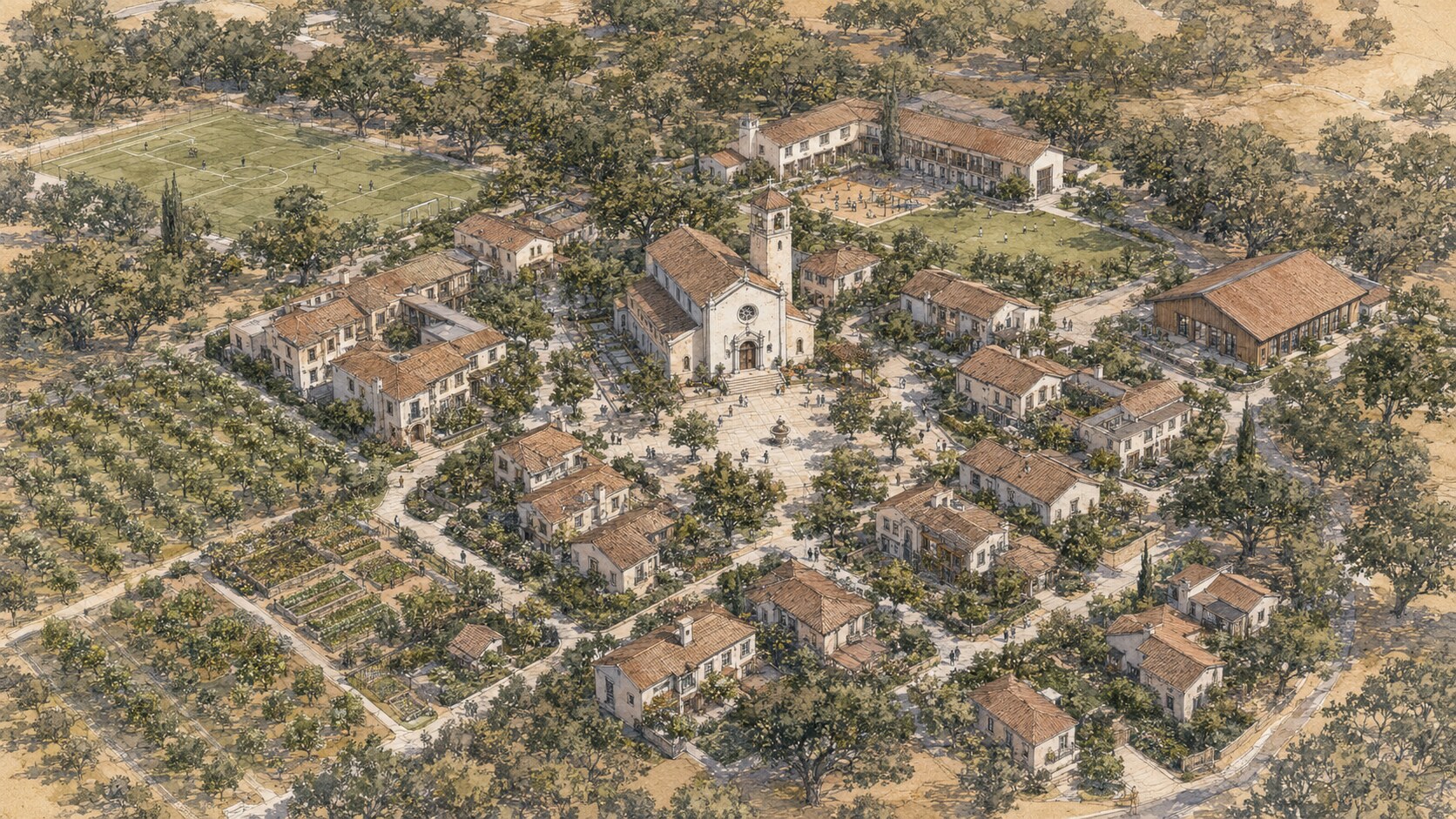
A church tower visible from home, a square where neighbors meet, a school within walking distance: the arrangement of a village gives daily life a shared direction.
That is why our villages begin with sacred order.
The church or chapel belongs at the heart of the village. Around it come the square, homes, school, gardens, workshops, places to eat, places to play, and the ordinary encounters from which community grows.
Principles for a living place
The habits and forms of life we want our villages to sustain.
The village is ordered toward God: church, prayer, the sacramental life and the rhythm of the Catholic year are woven naturally into ordinary life.
Beauty grows from sacred order. Traditional architecture, enduring materials, craftsmanship, gardens, art and sculpture create places worthy of being loved for generations.
Children should be able to walk to friends, school, sports and the village square, and gradually encounter the world without needing to be driven everywhere.
Shared values create greater trust. Proximity turns acquaintances into neighbors and neighbors into a genuine community.
Church, school, friends, recreation and community life should be close enough that walking is the natural choice.
The village should be a hub for the wider community, hosting lectures, debates, feast days and gatherings where friendships deepen, ideas are tested and new work begins.
Nazareth
Christian civilization is renewed in the home.
The life of the Holy Family at Nazareth was made of prayer, work, meals, relationships, responsibilities and ordinary days lived faithfully.
We want this ordinary life to have room to flourish.
Such a place asks something of its people: showing up for a neighbor, passing on the faith, raising children together and welcoming the stranger. The village gives these duties a home in everyday life.
Exploring our first village
California
A village rooted in faith.
Connected to Silicon Valley.
We are exploring a site in Menlo Park, California, for our first Catholic Village.
Our ambition is to bring the intimacy of village life to the heart of Silicon Valley: a place for families to put down roots while staying connected to the wider world.
The current concept places a chapel and public square at its heart, surrounded by homes and community amenities.
The current concept
The spiritual and social heart of the community.
The concept anticipates Chesterton Academy playing an important role in village life.
Traditional homes shaped around walkable streets, gardens and shared spaces.
A place for meals, lectures, celebrations, clubs and everyday community life.
Flexible infrastructure serving residents and the wider Catholic community.
A life where children and adults walk naturally between home, friends, fields and activities.
A Catholic hub for Silicon Valley
We see Silicon Valley as the Rome of our time. The tools and ideas made here reach into homes across the world, and people with the ambition to shape the future keep arriving. We believe that makes it the best place to begin. A Catholic village here can give families deep roots while bringing the Church’s intellectual and artistic inheritance into the work of building the future.
We want the village to be a meeting place for founders, scholars, artists, teachers and friends from across the Bay Area. Lectures, serious debate, shared meals, concerts and feast days would give the wider community reasons to return, and give new friendships and undertakings a place to begin.
Site exploration · 2026
We are exploring the Menlo Park site and developing the concept. Site arrangements and the plans are still being worked through.
If the project proceeds, we anticipate approximately three years of planning, organization, architecture and permitting, followed by roughly two to three years of construction.
Our hope is that the first families could begin moving in around 2031.
A community to last generations
Imagine leaving your front door and walking to Mass.
Your children disappear down the street to find their friends. You know the families living three doors away. School is around the corner.
Someone is baking bread for tonight’s gathering. There is a lecture in the village hall after dinner. Tomorrow there is football on the field. Next week the whole village celebrates a feast day.
The architecture is beautiful enough that people want to preserve it. The community is small enough that people know when someone needs help.
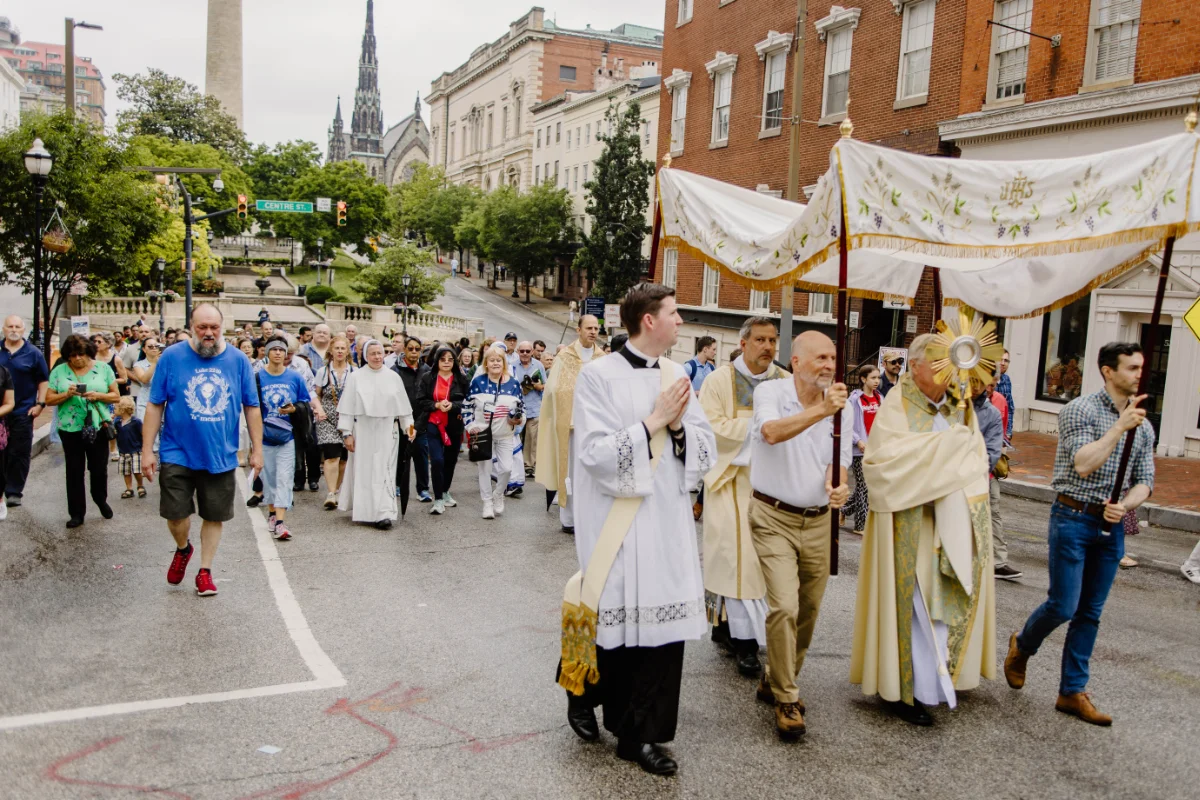

Children come to know the adults around them: the teacher who lives nearby, the craftsman at work, the elderly neighbor with time for a story. They see the faith lived through different vocations and stages of life.
For generations, communities like these passed on the knowledge of how to live together. We want our children to inherit that knowledge and add something of their own.
We can recover this way of life and leave it stronger than we found it.
Build it with us
Catholic Villages is still early enough that the people who join now can meaningfully shape what it becomes.
Interested in eventually living in a Catholic Village?
Traditional architects, developers, engineers, contractors and craftspeople who want to build places that endure.
Sacred artists, painters, sculptors, landscape designers, stoneworkers and makers who believe beauty belongs in public life.
People drawn to schools, children’s activities, formation, hospitality and the institutions that make a village alive.
People who want to help make ambitious Catholic institutions possible.
Long-term partners interested in a new model of faith-centered residential communities.
Good things often begin with people simply deciding to help.
Why we began
Catholic Villages began with a simple frustration.
We wanted our children to experience the kind of childhood that has become unnecessarily difficult to create: one in which they can walk out the door, find friends, explore, play outside, know their neighbors and grow up surrounded by a community that shares the things we consider most important.
We wanted to remain connected to dynamic cities and meaningful work without accepting that family life therefore had to take place inside sprawling, anonymous suburbs.
If the place we wish existed does not exist, why don’t we build it?
That became Catholic Villages.
A few practical questions
Here is where things stand today.
Our vision of a Catholic village brings homes, a church, a school, gardens and gathering places within walking distance of one another. Faith shapes the rhythm of daily life, children grow up among neighbors who know them, and shared meals, feast days and conversations draw the wider community into village life.
We are exploring a site in Menlo Park, California. The concept is in an early stage, and site arrangements and plans are still being developed. The images on this page illustrate the vision.
Our early hope is around 2031. The timing depends on securing a site, planning, permits and construction. We will share more concrete milestones as the project progresses.
Yes. Tell us a little about your family and what draws you to village life. Home types, pricing and ownership arrangements will become clearer as the plans develop.
We welcome people with experience in architecture, construction, education, art, community building, philanthropy and investing, as well as people willing to contribute time and care.
Find your way to contribute →A home near the church. Friends your children can reach on foot. A table with room for guests, a calendar full of shared feasts, and neighbors who become part of your family’s story. A place your grandchildren might one day call home.
Help us build it.